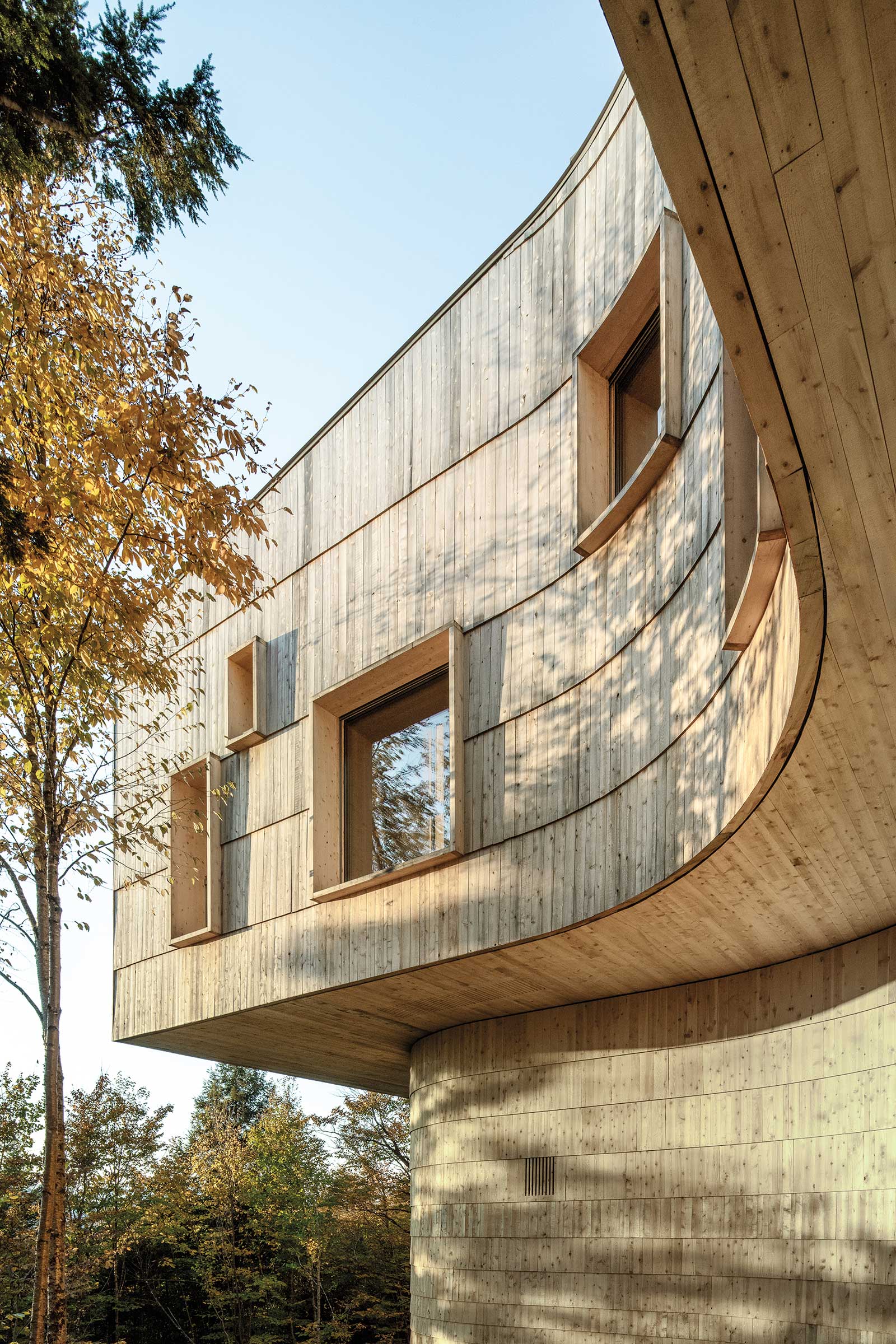
On a ridgeline in north central Maine, overlooking the Katahdin Woods and Waters National Monument, a building made of cedar, copper and light rises into view. It is not a museum or a gallery—and it was never meant to be. Tekαkαpimәk—pronounced deh gah-gah bee mook—is something else entirely: a living expression of what becomes possible when art, sovereignty and place are treated as inseparable. The name means “as far as one can see” in Penobscot. But it isn’t just a name—it’s a worldview, embedded in land, story and material.
Aerial view of Tekαkαpimek Contact Station. The design of the building and site draws inspiration from the confluence of rivers, evoking the flow of the Penobscot Watershed and welcoming visitors into Wabanaki territory. Credit: James Florio.
At Tekαkαpimәk Contact Station, the Wabanaki Nations—Maliseet, Mi’kmaq, Passamaquoddy and Penobscot—shape every aspect of the space. Their work does not sit behind glass.
It surrounds you: the Penobscot Watershed Floor Map, drawn by James Eric Francis Sr. (Penobscot) and etched into concrete by Spring Valley Corp.; a woven copper ceiling led by Gabriel Frey (Passamaquoddy); clay tile murals shaped in community workshops with Suzanne Greenlaw (Maliseet) and Wabanaki artists; and bronze door handles carrying a double-curve design drawn by Francis, shaped with the Wabanaki Advisory Board to represent each tribe, carved in wood by Frey, and cast in bronze alongside artists from all four nations.
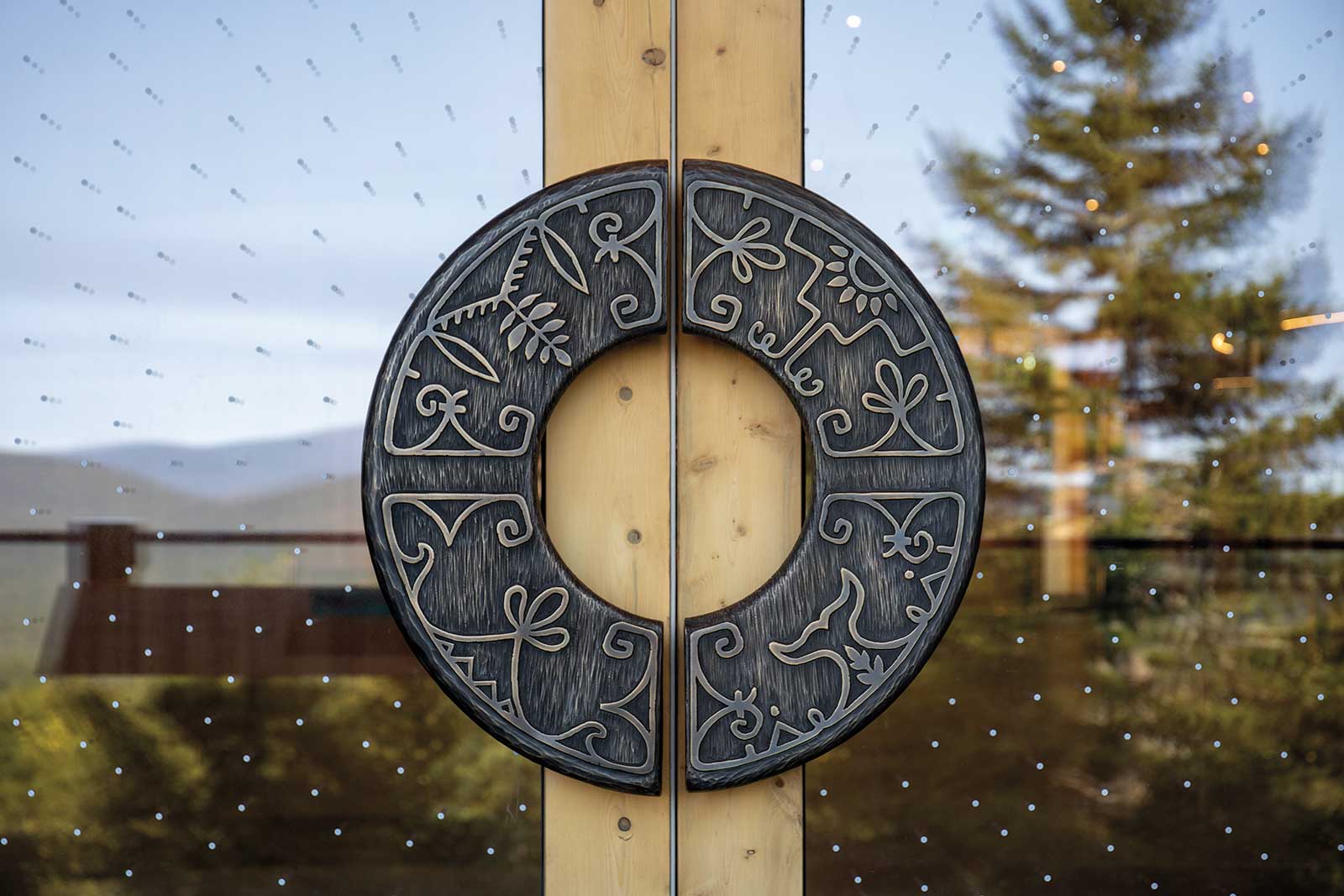
Cast bronze door handles at Tekαkαpimek Contact Station featuring the double curve motifs, with one representing each of the four Wabanaki Nations that symbolize the strength of the Nations united in support of each other, while maintaining their distinct identities. Credit: James Florio.
Stories move through beadwork, murals and the words of Jennifer Neptune (Penobscot), carrying relationships, histories and memory. Tekαkαpimәk does not treat Native art as separate from land, language or community. It refuses containment. It affirms that what is contemporary is also ancestral—and that Native artists are not just makers of culture, but keepers of knowledge, stewards of place and architects of political and spiritual belonging.
What makes Tekαkαpimәk remarkable isn’t just what it holds, it’s how it came to be. This building exists because Wabanaki people were recognized as the true stakeholders in their homelands. Because artists were trusted, not simply to decorate a space, but to shape it. And because love of community, political complexity and cultural continuity were treated not as obstacles but as guiding values. The result is a contact station that is also a model for how institutions can transform when Native authority is foundational.
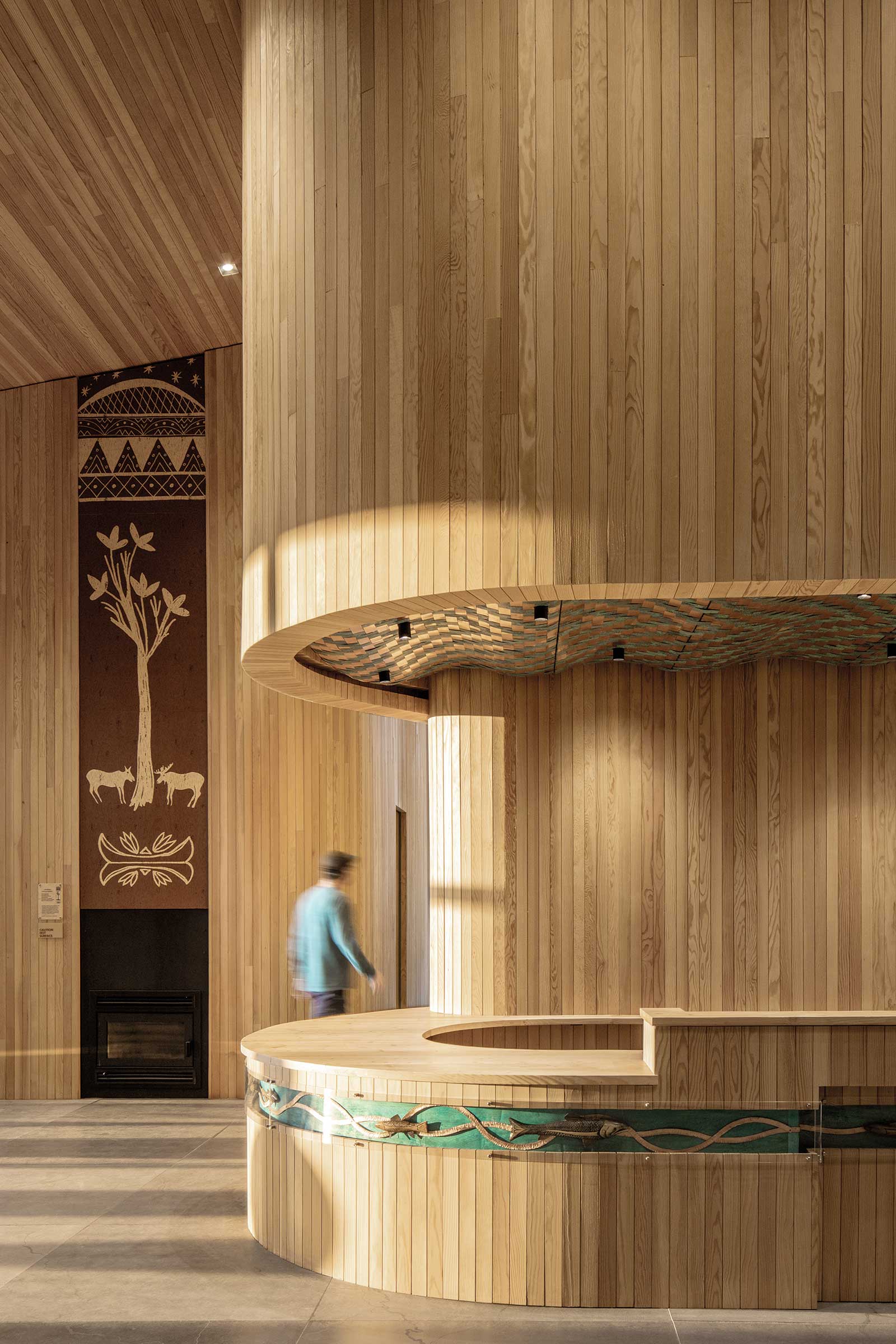
Interior view of the welcome area at Tekαkαpimek Contact Station. The desk features embedded Wabanaki symbolism, while above, a woven copper ceiling showcases the adaptation of traditional basketry in architectural form. In the background, a fireplace panel illustrates stories of cultural continuance. Credit: James Florio.
Tekαkαpimәk began as both a gift and a reckoning. When Roxanne Quimby and the Elliotsville Foundation (EFI) donated land for Katahdin Woods and Waters National Monument in 2016, they retained the right to build a visitor contact station. Early designs made it clear this could not be another park facility that erased Native presence. EFI turned to the Abbe Museum’s Native Advisory Council, whose work with Acadia National Park had focused on confronting extractive practices and advocating for shared storytelling. From those conversations came the Wabanaki Advisory Board—artists, culture bearers and leaders from all four Nations—who quickly rejected the first design, a New England farmhouse. “It didn’t reflect who we are,” says James Eric Francis Sr. (Penobscot). To their credit, the architects started over, with the board leading every step—design, materials, storytelling and legal protocols. With guidance from Dr. Jane Anderson, EFI examined how institutions have failed to protect Indigenous intellectual property and agreed to binding agreements that ensured the Wabanaki retained ownership of their cultural and intellectual rights. “This was the first time I saw a project that gave us space to tell our story in our own way,” says Gabriel Frey (Passamaquoddy). For him, the success was as much about what was protected as what was built. “It’s easy to support Indigenous engagement when it’s easy,” he says. “But what about when it’s uncomfortable?”
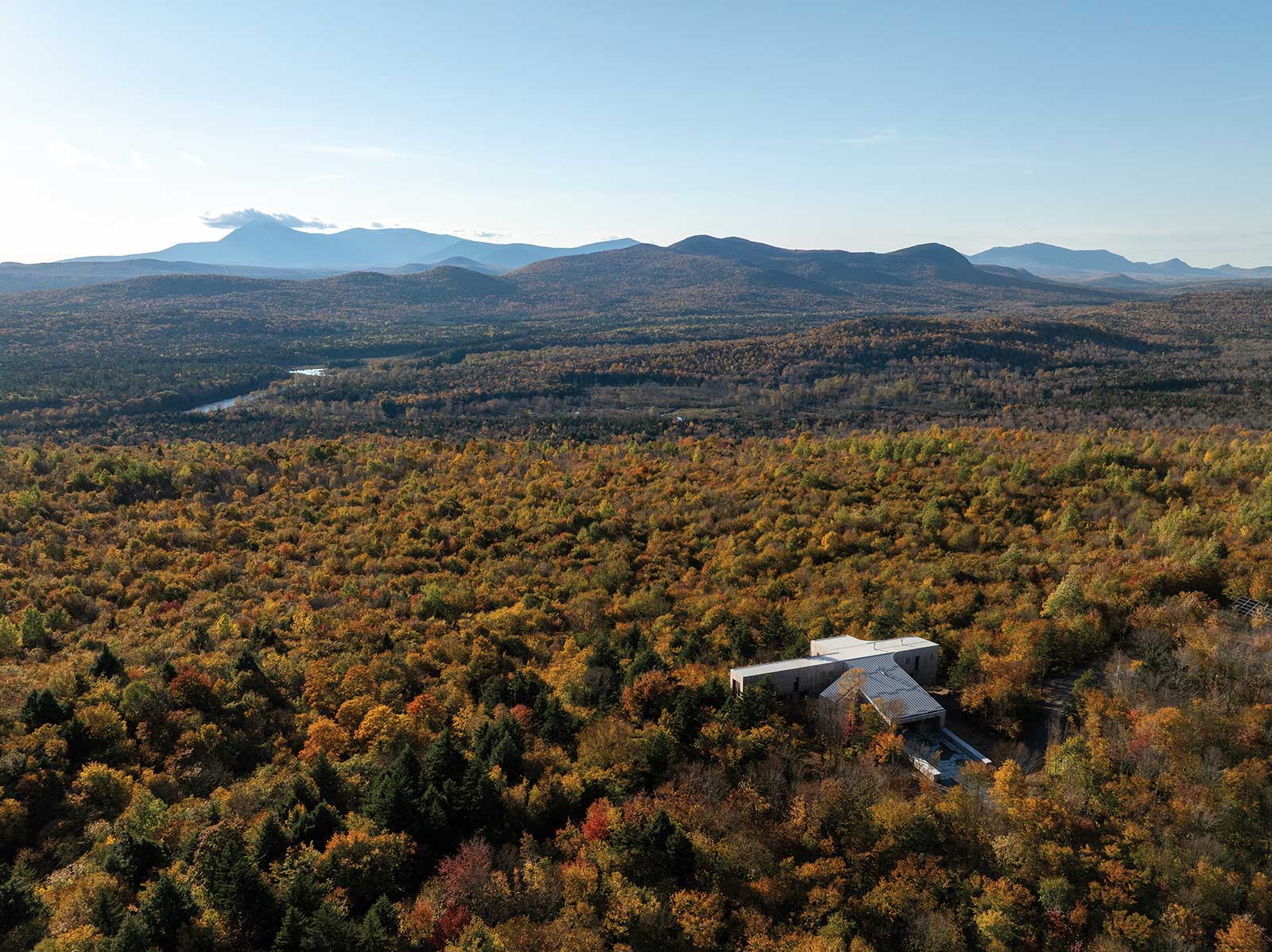
Aerial view of Tekαkαpimek Contact Station in autumn. The design of the building and site draws inspiration from the confluence of rivers, evoking the flow of the Penobscot Watershed and welcoming visitors into Wabanaki territory. Credit: James Flori.
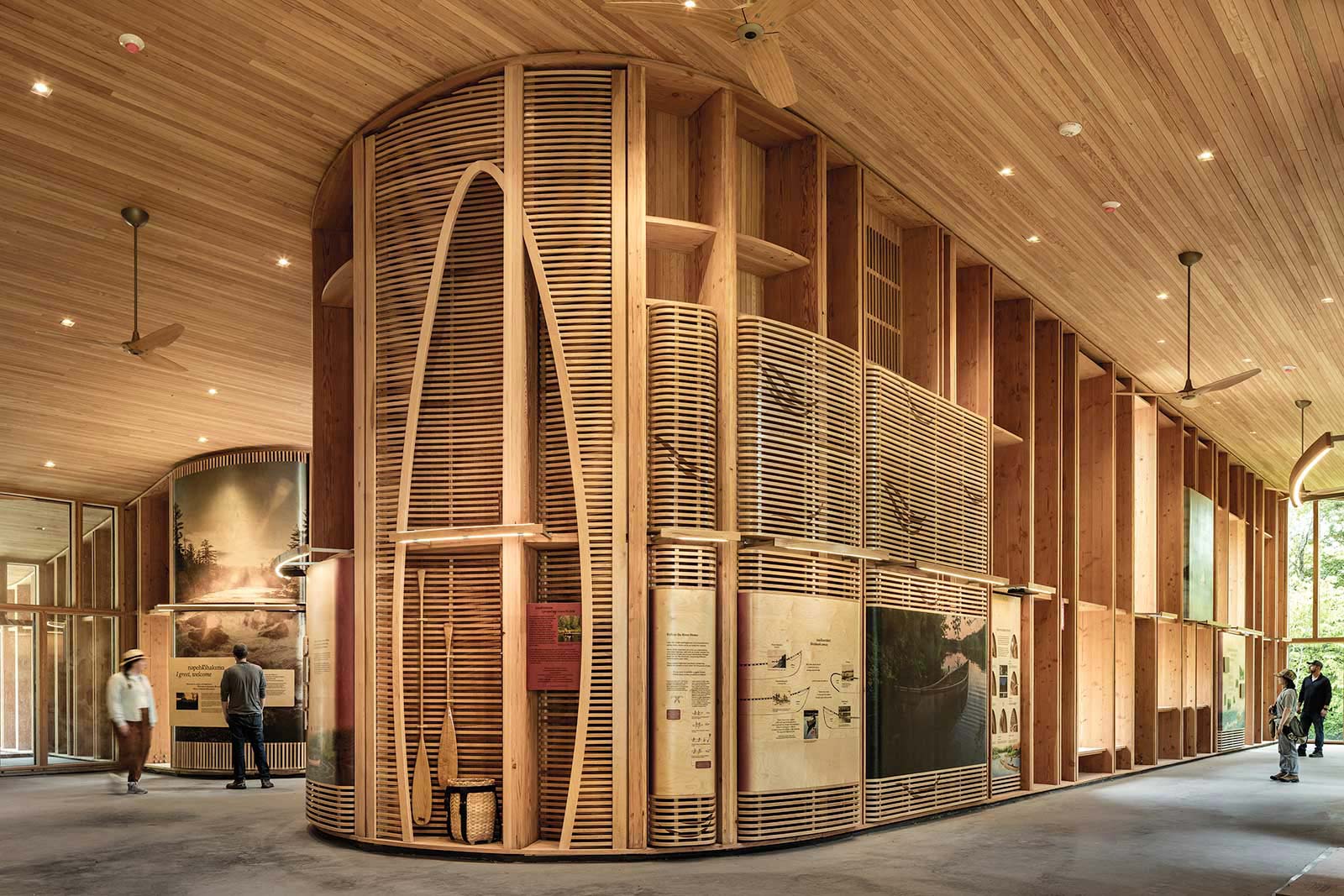
Interior of Tekαkαpimek Contact Station. Credit: James Florio
Above the Contact Station’s welcome and information desk, a rippling woven copper ceiling showcases the talent and artistry of basket techniques adapted by a team of Wabanaki weavers. Led by Frey, the team included Geo Neptune (Passamaquoddy), Richard Silliboy (Mi’kmaq), Sarah Sockbeson (Penobscot) and Shane Perley-Dutcher (Wolastoq–Maliseet), working with design and technical support from the Maine College of Art & Design. Beneath the desk, Perley-Dutcher’s carved fish reflects deep ties to water and the stories it carries.
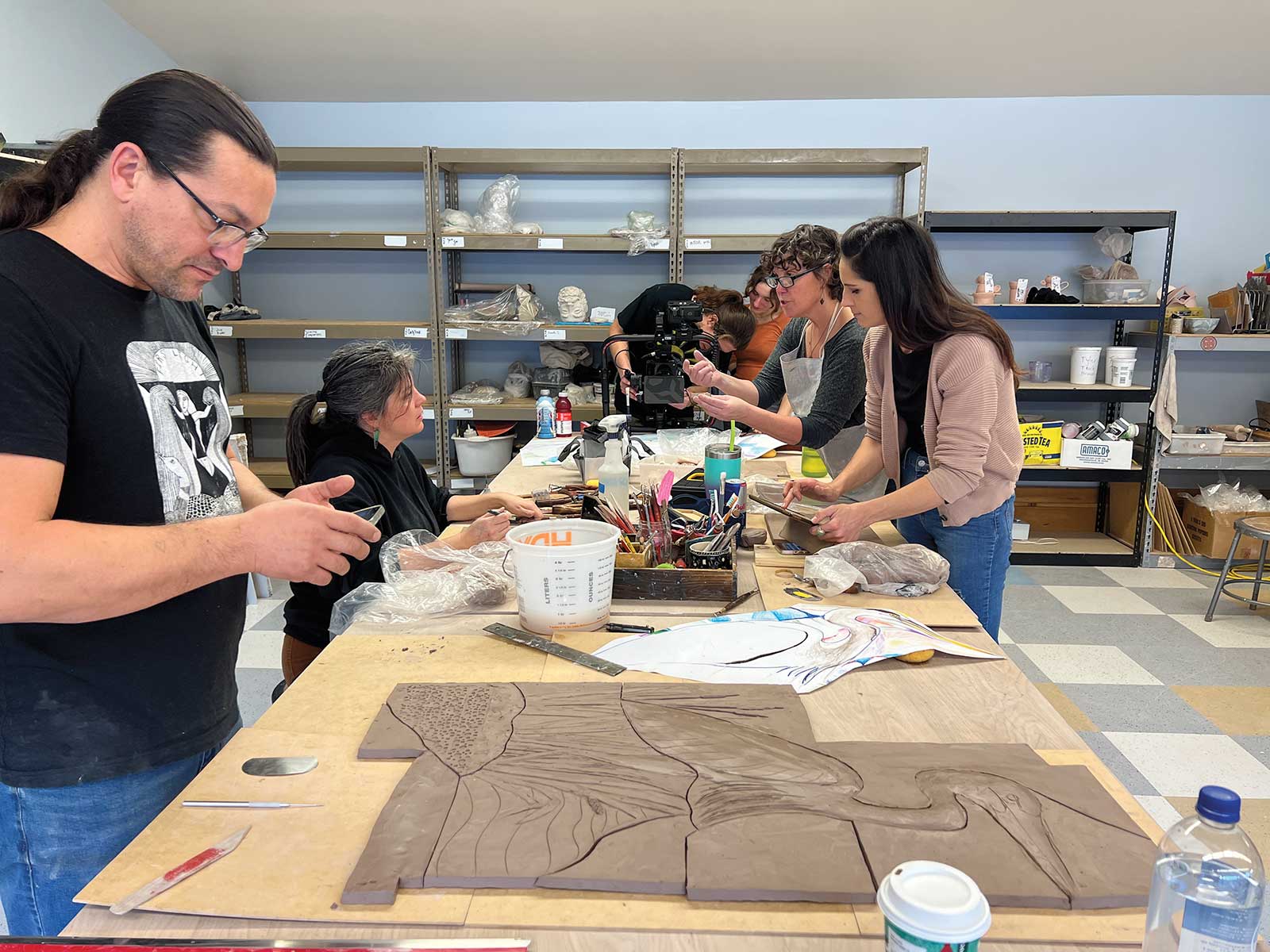
Artisan clay tile production for interior at Tekαkαpimek. Left to right: Gabriel Frey (Passamaquoddy), Suzanne Greenlaw (Maliseet), Nolan Altvater (Passamaquoddy), Giuliana O’Connell, Malley Weber, and Sarah Sockbeson (Penobscot). This collaborative project reclaimed Wabanaki ceramic traditions through intergenerational and intertribal creation of 75 unique tiles and two clay murals. Credit: Erin Hutton.
The clay tile murals, shaped in community workshops led by Suzanne Greenlaw (Maliseet), reconnected artists to a practice interrupted by colonialism—reviving local clay harvesting, mold pressing and pit-firing. As part of a Wabanaki-led ceramics initiative, the murals feature imagery rooted in Wabanaki culture, from local species and plant knowledge to the double-curve motif. Contributing artists include Cricket Griffith (Maliseet), Frey, Natalie Dana-Lolar (Passamaquoddy/Penobscot), Stephanie Francis Soctomah (Passamaquoddy), Greenlaw, Tania Morey (Mi’kmaq/Maliseet) and Nolan Altvater (Passamaquoddy). Production support came from Malley Weber of Hallowell Clay Works, with contributions from the Wabanaki Youth in Science (WaYS) program and guidance from Dr. Bonnie Newsom (Penobscot), an archaeologist focused on pre-contact lifeways of Maine’s Native peoples.
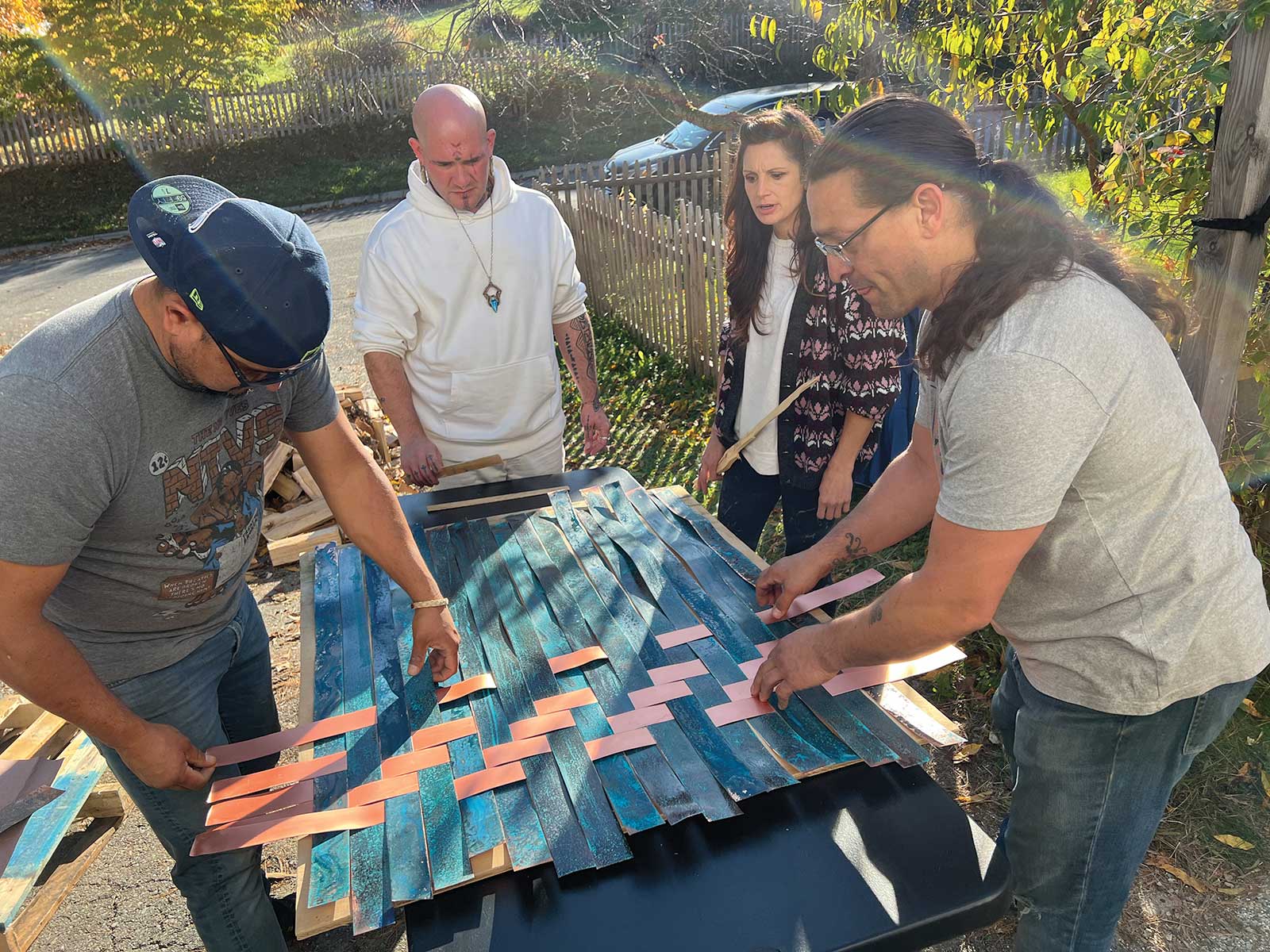
Welcome desk ceiling weaving in production. Left to right: Shane Perley-Dutcher (Wolastoq–Maliseet/Neqotkuk Wolasqiyik (Tobique First Nation, New Brunswick)); Geo Neptune (Passamaquoddy); Sarah Sockbeson (Penobscot); and Gabriel Frey (Passamaquoddy). The team used woven copper to reinterpret Wabanaki basket techniques for the architectural feature titled We Are Still Here. Credit: Erin Hutton.
Tekαkαpimәk embodies what’s possible when art, sovereignty and place are held as a continuum of care. It honors ancestors, speaks hard truths and shapes futures through collaboration with allies willing to listen and change. Here, memory travels as far as one can see, flowing backward into the deep past and forward into imagined futures, carrying both in the same current. —
Now open
Tekαkαpimek Contact Station
W99X+JF, Stacyville, ME 04765
(207) 456-6001, www.elliotsvillefoundation.org/tekakapimek
Powered by Froala Editor


